Affichage des articles dont le libellé est English. Afficher tous les articles

lundi 12 mars 2018

Adolphe Monod and Eugene Bersier


1. Facts 
 
We do not know whether Adolphe Monod and Eugene Bersier have ever met. As a matter of fact, the two men hardly had enough time to meet. Bersier came to Paris at the end of his divinity studies in February 1854 and left for Germany in July. He returned to Paris at the end of the year 1854 or at the beginning of 1855. At that time Monod was already seriously ill and close to giving up his ministry.

lundi 17 juillet 2017

Henriette André-Walther – a short biography


Henriette (Napoléone Joséphine Frédérique) Walther was born in Paris on June 14, 1807. Her father was Frédéric Louis-Henri Walther (1761-1813), son of a Lutheran minister [1] and commanding officer of the mounted grenadiers (grenadiers à cheval) of the Imperial Guard; his mother, Louise Coulmann (1783-1822), was the daughter of an advocate of the Regence in Bischwiller (Alsace).

Henriette was the couple’s second daughter; she had an elder sister, Louise (1803-1875). Their only brother, Napoléon Frédéric, died during his first year (1810).

The Walther family was quite close to the imperial court; Napoleon and his wife Joséphine expressed their desire to be Henriette’s godparents, but the baptism could only take place during the “Hundred days” (i.e. in 1815).

lundi 19 septembre 2016

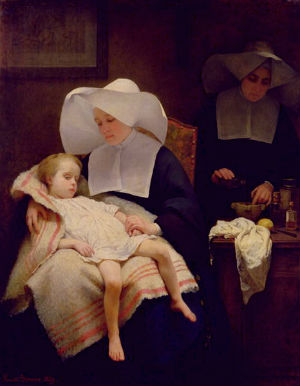
Adolphe Monod and the Deaconesses of Reuilly


The community of the Deaconesses of Reuilly was founded in 1841 by Antoine Vermeil (1799-1864) and Caroline Malvesin (1806-1889). Vermeil was a minister, first in Bordeaux and, from 1840 on, in Paris. Malvesin was a schoolteacher in Bordeaux and a parishioner of Vermeil’s church. Adolphe Monod moved to Paris shortly afterwards, in 1847. Have there been any connections between Monod and the young community?

mardi 29 mars 2016

Adolphe Monod and Caroline Malvesin


Caroline Malvesin (1806-1889)

In his monograph on the Deaconesses of Reuilly, Gustave Lagny (1912-2002)  provides us with some information regarding the life of Caroline Malvesin:

samedi 26 décembre 2015

Napoléon Roussel - a short biography


Although he was “one of the most dynamic evangelists of the Evangelical Society of France” [1] and “one of the most original figures of the Réveil” [2] , Napoléon Roussel is hardly known today. He is, however, well worth knowing, he of whom Jean Monod has said that “initiative, courage, fearlessness […] were the dominant traits of his character and life” [3] and that “the incisiveness of his word, his clear and logical teaching, the respect which his person commanded and his utter selflessness were striking” [4] . 

Napoléon Roussel was born in Sauve (Gard, Languedoc-Roussillon) on November 15, 1805 to Pierre Roussel (1775-1851), a former soldier in Bonaparte’s army, and Marie Rey (1770-?). Both parents worked in the manufacture of stockings.

mercredi 28 octobre 2015

Adolphe Monod and Louis Vallette


Louis Vallette (1800-1872)

Jean Louis André Vallette was born on May 24, 1800, in Chêne-Bougeries, a Swiss village on the border to Savoy (France). Having lost his father when he was young, he worked for some time as a tutor for the Boissier-Butini family in Geneva, which supported him in his studies. When studying theology in Geneva, he made friends with Antoine Vermeil (1799-1864), who later founded the community of the deaconesses of Reuilly, and with Frédéric, Billy and Adolphe Monod. (1)

mardi 8 septembre 2015

Adolphe Monod and Antoine Vermeil


Antoine Vermeil (1799-1864)

In his monograph on the Deaconesses of Reuilly, Gustave Lagny (1912-2002) describes the youth of Antoine Vermeil and the first years of his ministry as follows:

lundi 3 août 2015

Adolphe Monod - The Mercy of God


I have now made available my personal translation of Monod’s sermon La miséricorde de Dieu: The mercy of God (which is the second part to La misère de l’homme: The Misery of Man, also from 1828). You can download the file here

On my Monod site you can also read a short analysis and listen to an audio recording, etc.

vendredi 21 juin 2013

Adolphe Monod – The Mercy of God


This is the second part of a couple of sermons on Romans 11.32.

My notes on the first part can be found here.

Summary

Having reminded his listeners (and readers) of the key elements of the first sermon, Monod directly addresses those of his audience that have never undergone a conversion experience. He invites them to be worried because they find themselves in a situation of both guilt and misery. They need to be delivered “from the penalty of sin and from sin itself”, but they are unable to free themselves because even a perfect conduct cannot redeem their sins of the past, and is it impossible to build something holy on the bad foundations of the past. The only way out is found in God.

Monod thus undertakes to present God’s plan, but this time he bases his arguments only on the Word of God, because reason, which is capable of establishing man’s lostness, could not possibly imagine the solution God has brought about.

As a matter of fact – and this is at the very heart of the Gospel – God solves the problem of guilt by offering man his forgiveness. Man is unable to obtain justification through his own deeds and needs justification by faith, which is offered as a grace. It has its foundation in the work of Jesus Christ who has suffered the punishment we deserved.

Monod admits that this teaching surpasses his understanding and raises questions that he cannot answer, but he asserts that he can grasp it “by what precedes and what follows it”, i.e. through the answer it provides to the needs of his anxious conscience and through the peace it offers him.

God also overcomes the misery of man by re-igniting the love of God in him. As a matter of fact, whoever contemplates the work of the Son who offered his life for sinners, in the absence of any merit on their behalf, can only cry out: “What love! My God, what love!”

One might think that such love could only arouse man’s love for God in return, but as a matter of fact, it does not, unless man’s spirit is prepared by the Spirit of God acting upon it.

Monod establishes that the Spirit is not promised to the apostles alone, but to all Christians. He refutes several erroneous approaches and then concludes: 
“The action of the Holy Spirit is direct, real supernatural, exerted upon the spirit of man by a God equally sovereign over our hearts as over our nature, and who can at will give us and take from us our thoughts and feelings … The Holy Spirit is God in man.”
The preacher then summarizes what he has established so far: 
“God’s mercy has left nothing undone for the salvation of the sinner. Man needs a double deliverance; sinful, he needs forgiveness; wretched, he needs a change of heart, and God offers them both in Jesus Christ, who has suffered the punishment due to his sins. He changes his heart by showing his love through redemption, which the Holy Spirit allows him to believe and experience.”
This raises the question of man’s contribution – is there nothing man has to do?

Monod answers this question by asserting that man has to have a certain disposition of the soul – that he has to exercise faith. When speaking of faith, the preacher distinguishes “faith in God”, which is the “general conviction that the Bible is the Word of God”, from one of its consequences, “faith in Jesus Christ”, i.e. the “particular conviction that … we are all lost and may all be saved by Jesus Christ”. It is the latter that we have to have in order to be saved.

But how can we acquire this faith? Faced with the paradox that faith is a gift of God and that man is called to exercise faith, one might be discouraged, but in practice the way out of this dilemma is easy: it is sufficient to ask God for faith. And even if man has only a beginning of faith to offer, he should do so in order to benefit from this virtuous circle “from prayers to graces and from graces to prayers”, which will make him reach the way of God’s mercy.

Monod then addresses those who reject his discourse. He accepts the dismissal of the form, the language, the order of ideas, and everything else that has its origin in the speaker. Things are different when it comes to the content, the very ideas underlying it – the misery of man; his need for salvation in Jesus-Christ, by grace, through faith; the work of the Holy Spirit – whoever dismisses these doctrines rejects the Gospel itself. The sermon becomes very solemn in this place: 
“What I have preached to you is not my opinion. It is the truth. It is not my doctrine. It is the doctrine. It is more. It ist he life. If you do not believe it, you abide in death.” He who refuses it also refuses the declarations of the Reformed liturgy and has to ask himself why he comes to Church. “You must extricate yourselves in some way from so wrong a position; you must either go forward or backward; either take the thing or give up the name; receive the doctrine or admit that you are not Christians.”
Monod then has a word for those of his listeners who have been moved by his discourse. He invites them to turn to God and ask him for the grace of conversion, accepting to sacrifice whatever may be an obstacle, be it wealth or reputation, well-being, certain relationships, etc. “Turn me and I shall be turned!”

Monod terminates the sermon with a prayer in which he implores God to send his Spirit into the hearts of those who are inclined to conform to God’s will and ways.

Structure

Monod does not give any clear hints concerning the structure, but his discourse is logically ordered. There is no real exordium: the sermon begins with a summary of the most important elements of the first sermon. A possible structure could be:
  1. A twofold problem: guilt and misery
  2. The answer to guilt: propitiation in Jesus Christ
  3. The answer to misery: rediscovering God’s love
  4. The need for the work of the Spirit
  5. The requirement of faith
  6. Invitation to commit to the path leading to salvation

Why this sermon matters

This sermon is quite deep as to its theology. Monod tackles serious and complex matters – the biblical response to man’s guilt and misery, the doctrine of the Spirit, the theology of faith … – and he does so with great clarity. He admits that he does not have all the answers, but this fact does not hinder him from insisting on what God has definitely revealed in the Bible and outlining a pragmatic approach based on this revelation.

As Fredrik Dahlbom says in his thesis (1923), Monod’s insistence on the will to believe is original and rooted in his own experience: 
“In his own conversion, the volitional element was important. He had been a skeptic but his doubts had made him suffer. He wanted to believe, and this is why he had not given up the fight when it seemed most desperate. That being said, in Monod’s thought the insistence on the will does not contradict self-abandonment. Quite to the contrary, the will here designates the will to abandon oneself.”
One may also note the original distinction between “faith in God” (perhaps it would be more appropriate to speak of “faith in Scripture”) and “faith in Jesus Christ”.

Weaknesses

I would say that this sermon is very dense, and perhaps too dense, as to its theology. Monod uses few illustrations, everything is very intellectual and abstract – and yet the sermon is quite long (about fifty minutes). In other words, Monod puts the average listener severely to the test. It took an pulpit speaker of his calibre to sweeten this pill.

In his above-mentioned thesis, Dahlbom puts this weakness into perspective: 
“[Monod] wants to free religion from its slavery to which the Moralism of the Enlightenment had reduced it; he wants to bring her back home. But because of his understanding of revelation he forces her into a new slavery: the slavery of intellectualism. Very much like the Enlightenment confounded religion and morality, Monod and the Awakening run the risk of confounding religion and belief. Monod’s examination of faith in the sermon The Mercy of God provides a typical example. Monod distinguishes between “faith in God”, i.e. the belief that everything that God has said in his Word is true, and “faith in Christ”, i.e. the belief that there is a force that is distinct from ourselves, which cannot act before all that is false in us has been removed by self-abandonment. It is clear that Monod thinks that what counts is [faith as] trust, and that [faith as] acceptance and conservation [of the doctrine] only serves to establish a safe foundation for trust. But practically speaking the converse is true: he delves so deep into scholarly demonstrations that the things that should only have served as support for faith as trust has pride of place and pushes the aspect of trust into the background.”

Rhetorical elements

It is difficult not to note the three refrains that rhythm the second part of the sermon. First, there is, about halfway through the sermon, the fourfold exclamation: “What love! My God, what love!” Then, closer towards the end, Monod 14 times (!) repeats the question “Do you will to …?”, followed by 15 (!) repetitions of “It is the Gospel of …”. Each of these repetitions as such is quite efficient, but I would say that their accumulation is somewhat too much. Sometimes, less is more …

Miscellaneous

Monod’s list of authorities that endorse his Gospel proves him to be quite open-minded: we find not only Calvin and Luther, but also Fénelon, Thomas a Kempis and St Bernard. Not all evangelical preachers of today would be ready to invoke the support of all of these remarkable Christian men.

mardi 21 mai 2013

Gustave Monod on the Monod family


Gustave Monod (1803-1890)

The book “La famille Monod” (“The Monod family”), which Gustave Monod has published shortly before his death, is an indispensable source of information for whoever wants to deepen his knowledge on this family. The author, one of the “Twelve”, a renowned surgeon, has collected a lot of information on his ancestors, on his parents – Jean Monod and Louise-Philippine de Coninck – as well as on his brothers and sisters and their offspring. When Gustave talks about his parents and grandparents, he may well be a little too hagiographic but all in all his book is invaluable for its wealth of information.

You can download a facsimile version, found on archive.org, or a document in modern layout, which has the advantage of being searchable.

Also published on my Adolphe Monod website (here).

Adolphe Monod – The Misery of Man (updated)


May 2013: As of now an English translation and an audio recording of the latter are available.

This sermon is a beautiful example of truly evangelical preaching, completely in line with the values of the Awakening. It is the first part of a series of two sermons that should not be separated.

Context

This sermon partially stems from Monod’s period in Naples, where he was the pastor of the French-speaking church. It is is also the period during which he made a conversion experience. The sermon has been elaborated during his stay in Lyon and bears its marks. As a matter of fact, the young convert soon entered in conflict with the local church and its council, both of which adhered to the Enlightenment religiosity, which insisted on the pursuit of virtue and had completely abandoned salvation by grace, which the Reformation had rediscovered. Several of Monod’s remarks, and in particular the portrait of the “virtuous sinners” appear to be directed at this audience of respectable citizens who were proud of their achievements and thought that a life without scandal could open the gates of paradise to them.

Contents

This sermon aims at explaining and exposing the first part of Romans 11.32: For God has bound everyone over to disobedience … Monod explains that everyone encompasses both Jews and Non-Jews, of all times. He shows that there is a parallel text in Galatians 3.22 that allows to establish that disobedience here has to be understood as referring to sin. Finally, he asserts that the binding over to sin means that God has declared all men to be sinners. He thus reformulates the verse as follows: “God has declared that every man, in his natural state, is a sinner.”

Monod then justifies the apparent harshness of his assertions. Very much like a doctor, he wishes to administer a radical message in order to heal, rather than reassuring the sick by false securities.

He then goes on to explain the notion of sin, which must not be confused with vice. Man is a sinner because he has missed the goal his Creator had fixed for him, which is to love God more than anything else. This commandment is affirmed both in the Old and in the New Testament. As a matter of fact, the Bible teaches that man has failed; it is not the isolated texts cited by Monod that contain this teaching, but the Bible as a whole makes this assertion. Monod in particular refers to the first three chapters of Romans, which establish this doctrine with great clarity.

Monod then answers the objection according to which some texts only concern the people of Paul’s time. He warns against “that terrible error” that consists in adding to and subtracting from the Bible (see Revelation 22.18 et seq.) “under pretext of abstracting from our faith all that is unreasonable”.

Although he is certain of the biblical foundations of his assertion and their authority, Monod endeavours to demonstrate that reason itself comes to the same conclusions. God, both as the perfect being and in his dealings with mankind, is supremely worthy of love. Whatever is lovable has its origins in him; whoever goes to the origins of such things has to acknowledge that God must be the foremost object of our love. Any man who abandons this love is like a planet leaving its orbit around the sun, which exposes it to dreadful consequences.

Monod then shows that man does not at all come up to these expectations, loving other things more than God. The preacher draws a portrait of what the attitude towards God of an ideal Christian would be, thereby highlighting how far his listeners are away from this ideal. We do not love God as we should; all we do offer him is some “cold esteem”.

Monod then develops an intriguing typology of sinners. According to him, men are either “worldly sinners” who put their love on material things, or, which is less frequent, “affectionate sinners”, who love their family and friends over all, or, which is even more rare, “virtuous sinners” (!) who offer their greatest love to their duties and the requirements of their conscience. How many offer their first love to God? Following Paul, Monod finds that there is “none, not even one”.

The preacher invites his audience to open themselves to these assertions of Scripture and to let their conscience be troubled by them, which will make them receptive to God’s mercy.

The sermon ends accordingly with a prayer.

Structure

The structure of the sermon is rather simple.

The introduction is very short, i.e. it is contained in a single sentence (“The man who thoroughly understands this single verse has the key to the whole Bible”) This is extremely concise but quite efficient – who would not want to have the key to the entire revelation of Scripture?

The main part of the sermon is divided in three balanced parts: (1) exposition of the biblical teaching; (2) confirmation by what reason finds; (3) the types of sinners to which we belong, which brings us back to the biblical assertion according to which all men have gone astray.

A prayer forms the conclusion.

Rhetorical elements

Monod is not very much into rhetorical effects. He sometimes likes to repeat expressions: for instance, when defending the universality of biblical teaching, he repeats “If man is not in this condition of disorder …” three times in three successive sentences, and when he insists on the fact that his listeners are far from having the appropriate attitude towards God, he repeats “it is not true” not less than six times in six successive sentences. All of this is very unspectacular, from a rhetorical point of view.

Why this sermon matters

This sermon is fundamental in that it establishes the basis of the doctrine of sin held by Monod. It was the basic discovery underlying his conversion that one has to distinguish sin and vice. Monod thus attacks the concept of sin of Enlightenment Christianity and returns to the concept of sin as we find it exposed in particular in Paul’s writings.

The sermon also contains a powerful rebuttal of the liberal approach, which establishes human reason as judge of Scripture and feels free to abandon whatever is found not to comply with the requirements of reason. Monod contradicts Bultmann by anticipation and shows a very profound respect for Scripture: “When the Word of God thus explains itself, I do not need for myself any other authority.”

Weaknesses

I have the impression that Monod to some extent violates the verse on which his sermon is based when he asserts that God’s binding over to disobedience has to be understood as God’s declaration that man is a sinner. The idea that God makes declarations on man’s state underlies the biblical concept of justification (wherein God declares the believers to be righteous), and it may well be legitimate to presuppose an analogous declaration with respect to sin, but I cannot really find this idea in Romans 11.32, which rather suggests that God has decided to let man delve into his sin (see Romans 1.28: … God has given them over …). In contrast to justification, there is no need to declare man to be a sinner, his actions clearly manifest that he is. When Monod says that “it would be as unnecessary as it is easy to prove by all the Bible that [the expression “God has bound everyone over to disobedience »] does not mean that God constrains men to sin, but that He declares them to be sinners” he does not administer this proof ; as a matter of fact, he appears to introduce an element that is foreign to the verse he comments, which is questionable on behalf of a preacher who intends to be faithful to the Scriptures.

Other observations

This sermon provides a first example of a feature that is characteristic for Adolphe Monod: the use of illustrations from the world of the physical sciences. He compares man’s rebellion against God to a planet that leaves its orbit around the sun.

NB: This review, the original text and a facsimile, an English translation as well as an audio recording of the translation are available on my Adolphe Monod website (here).

jeudi 9 mai 2013

André Encrevé on Adolphe Monod


André Encrevé (1942-) is a French historian and probably one of the best specialists of the Reformed Church of France during the 19th century. Having graduated in history, he has been a researcher at the CNRS (1969-1975) and then lecturer in modern history at the university of Reims (1975-1988). He terminated his professional career at a university in Paris (1997-2007). In his doctoral thesis “Protestants français au milieu du XIXe siècle. Les réformés de 1848 à 1870 ”(“French protestants of the 19th century. The Reformed from 1848 to 1870”, Geneva, Labor et Fides, 1986, p. 125 et seq., we find a short portrait of Adolphe Monod:

*** My translation of the French original ***

“… Son of pastor Jean Monod, student of divinity in Geneva, pastor of the French colony in Naples – where he suddenly “converted”, following the original revivalist tradition – he then became pastor in Lyon. He soon entered in conflict with the Church council (which he presided before J. Martin-Paschoud became its president) because of his dogmatic beliefs but also because of his uncompromising character. After a long fight, he was finally revoked by the Church council in 1831. He stayed in Lyon and became the pastor of a small community of dissenters. But this ministry appears not to suit him. In 1836 his friends obtain his call as professor to the faculty of Montauban, which marks his return to the national Church. Incidentally, his teaching activities lead Monod to adopt a somewhat different doctrinal stance. For instance, he qualifies his former assertions on the plenary inspiration of Scripture. In 1847, he leaves Montauban for Paris, where he becomes suffragan pastor assisting pastor Juillerat. It is not so much his doctrinal originality – which is limited – but his eloquence that makes him famous very rapidly. Nowadays we find it quite out-dated and too grandiloquent, but in his days it was unanimously praised; he was quite successful in Paris (when he preached, the Temple de l’Oratoire was too narrow for all those who came to hear him. …”

In the collecive work “L’Oratoire du Louvre et les protestants parisiens” (“The Louvre Oratory and the protestants of Paris”), p. 121 et seq., Encrevé adds the following remarks on Adolphe Monod:

*** My translation of the French original ***

“… Although he was above all a pastor, most of his activity on Paris is centred on preaching. And indeed he is very successful and makes himself a name (very much like A. Coquerel) well beyond the protestant community. Paul Stapfer refers to him as follows:
I have seen the great Temple of Saint-Honoré street, the Oratory […] in profound silence, although it was full of seated and standing people, right until the steps of the pulpit and up to the galleries of the upper storeys, which were normally empty […]. I was struck by the silence before and after [the sermon], first the silence of expectation and then the silence produced by the sermon.
Today we definitely tend to find his eloquence out-dated, all the more so because he does not hesitate to try to provoke emotions and even fear in his listeners. Michelet said of him: “Whoever has heard him still trembles.” This being said, his eloquence was particularly appreciated by his contemporaries. E. G. Léonard calls him “the voice of the Awakening” and asserts that “others have spoken in the name of the Awakening with power and authority […] but none has had gained such an audience”. His ministry in Paris, however, is short, because he dies in 1856.”

Also published on my Adolphe Monod website (here).

jeudi 18 avril 2013

André Bieler on Monod and the Awakening


André Bieler (1914-2006) was a Swiss pastor and theologian. As one of the founders of the Bern Declaration in favour of development assistance (1968) he is considered to have been one of the foremost protestant specialists on ethics of the second half of the twentieth century. His book “Chrétiens et socialistes avant Marx: Les origines du grand malentendu », [Christians and socialists before Marx ; the origins of the great misunderstanding] Geneva, Labor et Fides, 1981, contains an interesting passage on Adolphe Monod and the Awakening movement (p. 46 et seq.)

*** My translation of the French original ***

“... In this context one would have to cite the long list of protestant organisations for evangelism, mission and mutual aid that proliferated during this period. […] One would also have to cite the life and dedication of the great personalities who have brought fame to the Protestantism of this time, thanks to the dynamism and self-denial produced by their living faith, which was a fruit of the Awakening. Many women of great worth have stood out by their persistent dedication in favour of philanthropic activities in which they invested their lives. We remember the great names: Monod, Hollard, de Pressensé, Lutteroth, Stapfer, de Broglie (Mrs de Broglie was Mrs de Staël’s daughter), Mallet, de Gasparin etc. All of them were part of business circles, members of the diplomatic corps, members of liberal professions or senior civil servants.

This notwithstanding, the political orientation of the members of the Awakening movement was not only backward-looking but very often counter-revolutionary. Adolphe Monod suspected the minister Oberlin, whose exemplary social work at the Ban-de-la-Roche we have mentioned above, of not being sufficiently religious. He wrote: 
“He was a very respectable pastor, but one may ask oneself whether the care he has taken of the temporal interests did not prejudice the development of the spiritual interests in some respects.” 
Looking down from his pious stance, he pronounced a very severe judgement on the silk workers of Lyons when they revolted at the beginning of the July Monarchy. In 1831, he wrote:
“We have asked God in particular not to deal with this poor people (the insurgent workers) according to its sins, to remember his children living in this town, whose number is greater than that of the just of Sodom, to spare the city because of them, to put a damper on the raging passions etc. At first, we were painfully agitated, but soon we received peace and we felt pleasantly tranquil. … While these awful scenes took place outside, everything was tranquil inside. You could have had the impression of going from the Kingdom of the demon to the Kingdom of Jesus-Christ by making just a few steps: we were reading his Word, we called upon his name, we rejoiced in the grace of him who had delivered us from the passions of natural man and who maintained our peace in the midst of the fury and the calamities which we had to witness …”
The attitude was the same during the 1848 revolution. The Methodist Louis Rostand has very well expressed the fear these events generated in the protestant groups he was familiar with:
“There is terror everywhere, he wrote, the crowds break the doors …; we fear looting, we fear arson, we fear everything; death is on everyone’s lips.”
Ami Bost openly expressed his disdain for the new regime:
“What a mean and miserable comedy the establishment of this Republic was!” he writes. “How come that pious persons could be mistaken as to the nature of this prank and forget what even Montesquieu, although he was not very much informed on religion, had discerned: that a Republic can only survive if there is a certain degree of virtue, which we have lost long ago.”
According to E. Léonard, most “pious people” held such opinions. However, he cites some exceptions: the pastor Léon Pilatte, who had a very humble background, who said that he was “sick with emotion and joy” when he heard of the advent of the Republic; the young Edmond de Pressensé, who was much more open-minded than his environment with respect to socialist aspirations – he was struck by the calm and the intelligence of the revolutionaries, “this intelligent, quick-witted, spiritual and good race”; and Mrs André-Walther, “the pietist of the high society of Paris whose Hôtel de la Trésorerie générale in Tours constituted a base for a runaway intelligentsia”. …”


NB: In his book La carte protestante. Les réformés francophones et l’essor de la modernité (1815-1848) [The protestant card. The French-speaking Reformed protestants and the rise of modernity (1815-1848)], Geneva, Labor and Fides, 1997, p. 90, William Edgar (1944-), a professor of apologetics, challenges these assertions. Having cited a passage from Adolphe Monod’s sermon Etes-vous un meurtrier ? [Are you a murderer?], he pursues:
*** My translation of the French original ***

“It is true that this approach to social problems is somewhat moralizing. But Bieler’s evaluation of Monod and his colleagues of the Awakening movement (“not only backward-looking but very often counter-revolutionary”) is too harsh. […] This sort of conservatism is rather found in the sermons of the first-generation preachers such as J.-I.-S. Cellerier. […] I think that [Monod] expresses an individualistic approach to social problems, which is commonly found in protestants (but also elsewhere). At that time, Monod thought that one first had to moralize the Christians in order to reach more global solutions later on. It is a sort of indirect apologetics, based on protestant principles.”
Also published on my Adolphe Monod website (here).

jeudi 11 avril 2013

Ami Bost - Divinity Studies in Geneva in the Early 1800s


Ami Bost (1790-1874) was one of the important men of the Awakening movement, which has had a significant influence on Frédéric, Adolphe and Guillaume Monod. In the following extract of his memoirs (1854) he gives an account of his divinity studies in Geneva.

*** My translation of the French original ***

“I began my theological studies in 1809.

This period was still strongly influenced by the character of the great French revolution, which had just come to an end. The doctrine – as far as the Church is concerned – and morality in general had reached a degree of laxness which one can hardly imagine today. The way in which the students lived – divinity students very much like the others – was in line with this attitude: what they said and sung, the scribbles on the benches, the behaviour of some, were beyond the tolerable.

As to the teaching, there is one major fact, which, although it may appear incredible, is true. During the four years of theological studies, except for the use of the Old Testament that was required for learning some Hebrew, by translating about a hundred psalms over the four years, we did not open the Bible in our lecture halls: this book was useless and unknown. In other words, it was not part of our courses, and apart its use for translation work you did not need to have it! I guess it was sometimes referred to, because of the beauty of some of its poetry or some oratorical movement, or in support of teachings said to belong to natural religion, comprising the resurrection and a judgment to come, but beyond that – nothing. As to the New Testament, as some of us knew the Greek language and the others were supposed to know it, this book was not used, neither for translations nor in any other way. There was no course on systematic theology, neither good nor bad, only pure deism, and I dare say, impudent deism (except for the fact that nobody was honest about it). Those were the studies and this was the atmosphere from which God has drawn, by his marvellous grace, most of the pastors and ministers who were most prominent in the awakening, among which Messrs Guers, Empeyta, Malan, Gaussen, Merle, Galland, and the author of this book. I was studying at the very same time as Mr Gaussen; Mr Malan had preceded us by two or three years; Messrs Galland and Merle followed us at a distance of one or two years.

From the scientific point of view, the situation was quite as miserable, and it could not have been otherwise. At that time the only aspect of theology that was cultivated to some extent was pulpit speaking, and even in this domain the substance was completely neglected because besides Saurin we studied a great number of Roman Catholic pulpit speakers such as Massillon, Bourdaloue, Bossuet, Réguis, and all the errors that their sermons hid under in beautiful words.

As to our spiritual education, we could only find help outside our studies, and in particular in the small assemblies to which we return all the time and which provided some slight remedy to our misery. It was about at that time (1810) that the Société des Amis, which I have already mentioned, was established. It has not lasted until the appearance of the awakening in 1816, but at that time it was a little bit more consistent than all its predecessors. We will come back on it soon. All of its – about twenty – members were male, most of them were young.

Considering this situation, you can imagine the sad effect that my theological studies had on me, [a young lad] lacking direction and full of contradictions. On the one hand, when it came to drafting sermons, I tried to exercise my oratorical skills; on the other hand, my spirit clung to the principle, which grew stronger and stronger, according to which, as far as rhetoric is concerned, the Gospel is a power from God and acts on a supernatural level, and as such has to be preached without any literary concerns and without any consideration of rhetoric. Later I found this principle expressed in Pascal’s great Art of Persuasion, where he openly says:
“I do not speak here of divine truths, which I shall take care not to comprise under the art of persuasion, because they are infinitely superior to nature: God alone can place them in the soul and in such a way as it pleases him.” […]
The outcome of this conflict in which I found myself was quite poor, and for a long time my colleagues and the public have considered me to be more narrow-minded than I really was.

Notwithstanding the decadent nature of the teaching and all my unfaithfulness, I presented myself as a defender of orthodoxy, and I was the only one in the audience to play this tiresome and dangerous part. As a matter of fact, Mr Gaussen, who was heading for the truth, still had not yet publicly expressed his opinions. That being said, I defended orthodoxy more as a theologian than as a Christian, and without any unction.

To give you an example of the contradictions that characterised my poor existence at that time, let me say that besides my reading of Virgil and Voltaire, and among many commitments, projects and futile pleasures, I drafted (from October 1 to 4, 1811) a quite elaborate and rather serious paper against dance. I still am in possession of that article […]. It begins in a very academic manner by “Sirs” but then I quickly address my listeners as “my brothers”. The article obviously is quite mediocre, but it still is an interesting document. Its amplified and monotonous style makes me smile; it certainly is not in my nature [to write in this way] but I had involuntarily adopted it by regularly reading tiresome Massillon, as I had been told to do!”

Also published on my Adolphe Monod website (here).

vendredi 29 mars 2013

Coquerel on Jean Monod


In his book Observations pratiques sur la prédication (Practical observations on preaching, 1860, p. 24) Athanase Coquerel the Elder (1795-1868) tells us about an encounter with Jean Monod (p. 24):

*** My translation from the French ***

“I remember that shortly after my return to Paris, following my graduation from the Montauban faculty, Jean Monod, the venerable pastor with whom my family has had the most intimate relationship, right until the baptismal fonts, and whose preaching was both so liberal and so full of unction, asked to see me. I had just sat down in his study when he rose, took one of Saurin’s volumes, opened it towards the end of the sermon on eternal punishment and said: “Please read this to me.” He listened very carefully, without ever interrupting me, and then encouraged me in a very well-meaning manner, and offered me some critical advice on the inflections and redundancies of the intonation of this passage, which I have tried to make use of and which is still present to my mind after so many years.”

Several aspects seem noteworthy:
  • Monod is referred to as “venerable pastor”. This is something that we can see in most witness testimonies: Jean Monod appears to have been a quite impressive person and the object of genuine veneration on behalf of his parishioners.
  • A liberal such as Coquerel qualifies Monod’s preaching as “so liberal and so full of unction”.
  • In Jean Monod’s (and his sons’) time Jacques Saurin (1677-1730) was considered to be the prince of the protestant preachers. Incidentally, we know that Adolphe Monod had a collection of Saurin’s sermons in his baggage when travelling.
  • Monod has a sermon on eternal punishment read out to him and then insists on the best intonation. The men of the Enlightenment did not take this doctrine quite seriously, unlike their successors of the Awakening movement.
Also published on my Adolphe Monod website (here).

lundi 18 mars 2013

Jean Monod - Impressions of a young listener


Portrait of a young lady (about 1810)

Charles Adrien Bost (1871-1943) has published two little documents written by his maternal great-grandmother, Julie Devillas (1791-1869) in the Bulletin de la Société de l’histoire du protestantisme: a passage taken from a letter she had written to her mother, Louise Tessier (1754-1821), in 1810, and a notepad entry. These documents are interesting because they tell us something about Jean Monod’s reputation as a minister and indicate a possible weakness of his way of delivering sermons.

In her letter, the young lady (she is 19 years old) apologizes to her mother for being late in answering her letter. She then mentions a sermon given by Jean Monod on May 13:
“I would like to think that you will forgive me because the reason [for my belatedness] is quite commendable. Let me tell you that I attended the Sunday service to hear Mr. Monnot (sic), the greatest of the ministers in Paris. I was very happy to listen to his discourse, which was very beautiful, and I have decided to offer you a sample of what is being preached in this country. …”
Unfortunately, this summary has not been preserved. In her notepad of June, Miss Devillas mentions Jean Monod once more:
“Saint-Thomas-du-Louvre (Saint-Louis) has been given to the Reformed protestants so that they could celebrate their offices there. It is a small church, and I do not find its interior satisfactory. I consider the fact that the two sexes are mixed in one place the only purpose of which is to listen to the Word of God to be at least useless, and quite contrary to the spirit of meditation that should pervade each of the church attendees. Indeed, who of us has never made the experience how quickly the mind … I have heard Mr. Meonnod (sic), the foremost of the protestants pastors in Paris. I was very pleased by the wise exposition of his discourses and the pure moral that flows from them. It is quite a pity that his delivery does not support the beneficial effect produced by his words.”
Source: Bulletin de la société de l’histoire du protestantisme, April-June 1936, p. 143

Also published on my Adolphe Monod website (here).

dimanche 10 mars 2013

Jean Monod (1765-1836)


Jean Monod was born on September 5, 1765, in Ambilly, a small village half-way between Annemasse (Haute-Savoie) and Geneva. He was the eldest son of Gaspard Joël Monod (1717-1782), a former pastor and chaplain of the British governor of Guadeloupe, who had retired to Geneva as a translator and man of letters, and his wife Suzanne Madeleine Puerari (1739-1799), whom he had married in 1763. All his life, Jean was committed to Geneva, which he considered to be his home.

Jean received his first school training by his father (he later said that his “first education, of which his father took care, was faster than the one you got in school”). He entered the Première in 1776, and began his literature classes in 1777 and philosophy in 1780. He then decided to follow the example of his father by becoming a minister. He began his theological studies at the University of Geneva in 1782, which was also the year in which his father died. He proved to be a brilliant student. In 1785 he defended his thesis on The gift of tongues; in 1786 he passed the sermon exam before the Vénérable Compagnie des pasteurs with a sermon on 1 Corinthians 4.5. He was ordained pastor on March 12, 1787.

In 1790, the Russian tsar Alexander I appointed one of Jean’s cousins governess of one of his daughters. Jean accompanied her to St. Petersburg. On his trip home, he decided to visit Stockholm and Copenhagen before returning to Geneva. He visited his former fellow student Ferdinand Louis Mourier (1754-1831), who had then become pastor of the local Reformed Church. When doing so, thanks to the “umbrella incident”, he was presented to the family of Frédéric de Coninck, a wealthy businessman of Huguenot origin. Julien-Pierre Monod tells the story: 
“During a walk in Copenhagen, a rain shower surprises Mourier and his friend . They are before the entrance of the beautiful residence of Frédéric de Coninck, businessman and state councillor, one of the foremost parishioners of Mourier’s church. Mourier goes up in order to borrow an umbrella; the family asks him to stay; he mentions the friend who is at the entrance; “Ask him to come in”, he is told. Thus Jean Monod is presented to the de Coninck family, and this presentation will have very important consequences for him.”
Indeed, Jean fell in love with Frédéric’s daughter, Louise-Philippine de Coninck (1775-1851) who was then sixteen years old.

Having spent several months in Copenhagen, Monod finally travelled to Berlin in 1791 and then returned to Switzerland. He came back to Copenhagen in 1792 and married Louise on January 18, 1793. He was twenty-even, and his young wife seventeen years old.

The young couple then left for Switzerland. Their first son, Frédéric, was born in Monnaz, not far from Morges, in 1794. In the very same year, Jean was invited to return to Copenhagen to replace one of the pastors of the French Reformed Church. He was a minister in this church for 14 years. During this period, seven children were born: Henri (1795), Adèle (1796), Edouard (1798), Guillaume (1800), Adolphe (1802), Gustave (1803) and Valdemar (1807).

Jean Monod made a trip to London and Paris in 1798. He was invited to preach in the Reformed Church of Paris and made a good impression.

In 1799 he lost both his mother, who had followed her son to Copenhagen, and his sister.

In 1807, the British government pretended that Napoleon and Alexander I had a plan to attack England by means of the Danish fleet; it summoned Denmark to hand over its ships. The Danish government first refused, but it gave in after intense bombings. This had the effect that Danish commerce came to a standstill. The business of de Coninck’s establishment was greatly shaken.

At that time, the Reformed Church of Paris had three pastors, all of whom had been appointed by Napoleon: Jacques Antoine Rabaut, also known as Rabaut-Pommier (1744-1820), Paul-Henri Marron (1754-1832) and Jean-Frédéric Mestrezat (1760-1807). Shortly after Mestrezat’s unexpected death in 1807, the Council invited Jean Monod in 1808 to become his successor. In view of the misfortune of de Coninck’s establishment, Monod accepted this call. His family arrived in Paris on December 1, 1808. Jean was installed on December 26 by Rabaut-Pommier and gave his first sermon on January 8, 1809. He was presented to the Emperor on January 24, after the latter’s return from Spain.

Five more children were born in Paris: Marie (1809), Edmond (1811, who died the same year), Horace (1814), Elisa (1815) and Betsy (1818).

In 1811, his father-in-law died. According to Jean, Frédéric de Coninck was “one of the best and most lovable men who ever existed”.

In 1814, “it is with the greatest joy that he [saw] the fall of Bonaparte and the return of the legitimate rulers of France, as well as the return of universal peace.”

The University of Copenhagen offered him the title DD honoris causa in 1817.

In 1818 he assisted the ordination of his son Frédéric in Geneva. He installed him as a deputy pastor of the church in Paris in 1820.

At that time, Jean Monod was a highly respected pastor; in 1820 he was awarded the Cross of the Legion of Honour.

The last years of his life were overshadowed by sorrows and tensions with those of his sons who had chosen a pastoral career.

Jean was a helpless observer of Adolphe’s great crisis from 1824 to 1827. When Adolphe adopted the ideas of the Awakening movement, his father, who was a representative of the religiosity of the Enlightenment, found it hard to understand. Julien-Pierre Monod, one of Adolphe’s grand-sons invokes a “gulf of misunderstanding that cannot be explained by the generation gap alone”.

Tensions between Frédéric Monod – who also was a follower of the Awakening movement; he even left the Reformed Church in 1848 – and his father appeared when Charles-Frédéric Grawitz (1804-1852), who had studied theology in Montauban, wanted to be ordained in the Temple de l’Oratoire in Paris. His request was granted in 1827. Frédéric Monod and his colleague Henri François Juillerat-Chasseur (1781-1867) declared that “their conscience did not allow them to assist in this ordination”. They sent an open letter to all pastors of France and Geneva in which they accused Grawitz to “profess wrong fundamental doctrines that contradict Holy Scripture”. This was a very painful experience for Jean Monod, who had approved of the ordination of Grawitz. He wrote to Adolphe:
“You have received the letter sent to all pastors of France and Geneva, signed by Monod the Younger, wherein it is established that Monod the Elder leads souls to perdition. I am telling you this without complaining. Eleven or twelve years ago, when I was told that Malan had pronounced the damnation of his father, I have vigorously protested against this monstrous extravagance, and I would not have believed that it could happen again, close to me. Today I receive this with great sadness, and I believe it is a sad omen for our churches, but I accept it as a testing that Providence has kept in reserve for my old age, and I find it to contain two reasons to be satisfied: the first is that I can truly say before God that I do not feel the slightest bitterness in my heart; the second is that it strengthens my beliefs and makes me happy that I do not hold those who declare themselves judges over the salvation and damnation of other men. As the life and the teachings of the Methodists – NB: this was the common moniker for the followers of the Awakening movement – (very fortunately) are but a composite of contradictions, I have no doubt that my sons will be to me until my end what they have always been – the best of sons.”
As to Guillaume Monod, he displeased his father by adopting the doctrine of predestination. Guillaume was appointed pastor of the Reformed church in Saint-Quentin (Picardy) in 1828. He appears to have been somewhat exalted in the exercise of his ministry, which created tensions, and announced more serious trouble to come.

The problems Adolphe faced as pastor of the Reformed Church of Lyon from 1829 on also were a source of deep sorrow for his father, who disapproved of Adolphe’s hard doctrinal stance.

The year 1832 was particularly eventful:

On March 19, Adolphe was deposed as a minister of the Reformed Church of Lyon, by royal ordinance. His father greatly disapproved of his son’s subsequent activities in the evangelical reformed church of Lyon.

On May 5, Guillaume was committed to a psychiatric facility after he had presented himself at the Tuileries Palace in order to transmit a divine warning to the king Louis-Philippe. After a six-month stay in the lunatic asylum in Vanves, he was transferred to the asylum in Fishponds near Bristol (England) where he was locked up for four years, until after the death of Jean Monod, whom he held responsible for this situation.

When the president of the Council of the Reformed Church of Paris, Paul-Henri Marron, died from the cholera on July 31, Jean Monod was appointed as his successor. Frédéric became a pastor in title.

In 1835, he made a last trip to Geneva for the celebration of the Reformation Jubilee. His health rapidly declined during the winter.

Jean Monod was pastor of the reformed Church of Paris until his death on April 23, 1836, at the age of 70, as a result of a heart disease. A huge crowd of about 3000 persons, comprising 57 pastors, attended the funeral at the Père-Lachaise cemetery in Paris.

During his lifetime, Jean Monod had allowed the publication of only one single sermon, celebrating the peace of 1814, but his family has kept a collection of 51 sermons in six volumes, which it has given to the Vénérable Compagnie in Geneva. The publication of a selection of sermons had been envisaged by his widow and his four sons who had become pastors (Frédéric, Adolphe, Guillaume and Horace) but the idea has finally been abandoned.

Jean Monod has also left a translation of the letters of the German theologian Franz Volkmar Reinhard (1753-1812), on his studies and his career as a preacher. He has also contributed about fifteen articles to Louis-Gabriel Michaud’s Biographie Universelle, one of which dealt with his father.


Main sources:
  • Gustave Monod, La famille Monod, 1890
  • Julien-P. Monod, Jean Monod (1765-1836), Bulletin de la société de l’histoire du protestantisme, 1936, p. 117-142
Also published on my Adolphe Monod website (here).

mardi 12 février 2013

Coquerel on Adolphe Monod


Athanase Coquerel the Elder (1795-1868), who was a pastor at the Temple de l’Oratoire in Paris at the same time as Adolphe Monod and an arduous advocate of liberal theology, writes in his book Observations pratiques sur la prédication (Practical observations on preaching, 1860), p. 257:

*** Translation of the French original ***

“… To be sure, in all of these examples, art serves faith. Having said this, it is almost unbelievable that some have recently set forth the following principle: the more preaching flourishes in a Church, the less religious life develops in it. This paradox is all the more surprising on behalf of those who appear to want to accredit it because the latest example of outstanding preaching in their line of convictions constitutes a double denial of this strange idea. I refer to the career of Adolphe Monod as a pastor and professor, and his reputation. I do not wish to present myself as his critic or panegyrist. All I want to say is that those who asked him to give up his post as a professor to become a suffragan most certainly were not animated by the fear of pulpit eloquence being considered more important than it should. Also, if ever Christian preaching was the fruit of thoughtful artistry, it was his. It is well known that his most noted sermons were elaborated with great perseverance; he constantly improved them when he went from church to church during his missionary travels. His oratorical delivery was also the result of a very skilful and thoughtful exploitation of the resources of oratorical art, which most certainly did not diminish the power of his convictions …”

Also published on my Adolphe Monod website (here).

samedi 9 février 2013

Guizot on Adolphe Monod

 
Guillaume Guizot, son of the famous French statesman and historian François Guizot (1787-1874) is the author of the following article published in the “Journal des débats politiques et littéraires” (Journal of polictical and literary debates) on April 11, 1856, i.e. a few days after the burial of Adolphe Monod. Guizot acts on the maxim de mortuis nihil nisi bene but his article is interesting because it shows the impact of the preacher’s death on the protestant high society of Paris and because Guizot tells us something on Monod’s oratorical skills which the reader of his sermons can only imagine.

A very interesting article (in French) on Guillaume Guizot can be found on the great site dedicated to François Guizot (here).

*** Translation of the French original ***

Adolphe Monod

Three days ago, the Journal des Debats has announced the death of Mr Adolphe Monod. His funeral has taken place on Tuesday at 1 o’clock. The crowd was large, our loss is immense. All protestants, even outside France, know what Mr Adolphe Monod meant to the French protestant churches, and even to those outside the protestant churches; all those who have heard his voice or read his writings, all those whose spirits lift themselves up high enough, all those who have enough of the Gospel spirit to acknowledge Christian life and eloquence, in whatever communion they are found, will share our deep regrets. As all admit, the excellent man whom we have lost was one of the foremost Christian speakers of his time. It often pleases God to bestow his force onto humble instruments which then accomplish real miracles through him and for him, and each of whose victories benefits their master all the more as they have at first overcome their proper inadequacy in his name. But often, in order to honour his law and his church before the world, it also pleases him to attract a man who would have made himself known anyway, who would have been one of the elect of human glory, even if he had not been an elect of divine truth, and who attests to the religion of the simple and the weak that it also fits the strongest intellects and the greatest hearts. Then haughty and self-serving mankind, seeing its rebellion defeated by those whom it was tempted to despise, and abandoned by those in which it hoped to exalt itself, pushed to its limits by this double refusal of its self-adulation, admiring in the God who called the little children to himself and bent over their little heads the very God who, when he was still a child, proudly spoke with the puzzled Pharisees, has to acknowledge as its king him who dominates it where it thought it was powerful and supports it where it felt weak. The Christian faith, eloquence and humility of Mr Adolphe Monod, and above all his humility, which both veiled his rare and original talents to himself and enhanced them in the sight of other people, made of him one of those impressive examples, one of those living lessons that humiliates all those who despise the Gospel. It is one of the prominent features of Mr Adolphe Monod that he was an original thinker and speaker and at the same time a very constant, scrupulous, I would even say passionately obedient disciple of the Gospel. No one has attached himself more strongly to the “rock of ages” of which an English poet speaks. No one has made more living waters flow from it. He was a submissive Christian, using the riches of a very independent and creative personality for the benefit of the task that had been assigned to him. He himself has unknowingly explained his own merit when, speaking of St Paul, he tried to explain, how God keeps the human personality intact in those who he chooses to be his spokesmen and whom he has sealed. “The Spirit of God, so he says, unites himself with the spirit of man when he inspires him, very much like the divine nature unites itself with the human nature when it incarnates. If the Son of God who is present in Jesus-Christ does not hinder the son of man from participating in the pain of bringing forth salvation, the divine word vibrating in the human word of the apostle does not hinder the human word from participating in the labour of announcing salvation. God and man in the first case, the spirit of God and the spirit of man in the second, do not attenuate each other, they remain intact, side by side. Thus any word taken randomly on any page written by our apostle, although it is found in the celestial regions of the divine spirit, can nonetheless be traced in the inmost depths of the human spirit, in the lessons of experience, in the bitterness of trial, in the shaping and development of the new man, in the long apprenticeship of spiritual life.” What Mr Monod said on the inspiration of St Paul also holds true for the eloquence of Mr Monod. May others tell the continued efforts, the ardent pursuit of truth and the inner conflicts that strengthened and softened this austere and tender soul for the exercise of the sacred ministry – whoever has heard sermons of Mr Adolphe Monod can testify that the more the text was well-known and the more the thoughts were literally drawn from the text, the more the listeners were surprised by the unexpected life that the very person of the speaker imparted to his discourse. A very clear structure, a very broad vision, a very penetrating look at the hidden corners and trickery of the hearts, thousands of poetic or fixed expressions of Holy Scripture that almost unintentionally escaped his memory and amplified the authority of his word, great mastery in choosing examples in the history of the old covenant and Christianity as illustrations, a deep feeling of the fears and weaknesses of this time, the boldness to come straight to the point where he felt reason was most embarrassed, a very fine and creative language, sometimes a whiff of grave and painful irony directed at human folly, and above all, the pressing need to persuade, to win souls, the persistent fear of not having done enough to snatch sinners away from the false security that is their ruin and to lead them to the faith that saves them, the kind insistence of this Christian who appeared to consider his own salvation as much in danger as that of his brothers if he did not give his utmost to and for them, and finally, at the end of each sermon, once the subject had been dealt with, the emotional appeals of three or four successive perorations, increasingly pressing and beautiful – all this has contributed to making him one of the foremost preachers in the protestant Church. All his sermons that have been printed stand that test and will stand the test of time. But his penetrating accent, his serious, tired face, illuminated by a secret fire, his trembling and sincere voice, his sober gesture, the part of eloquence that we call action and which in him deserved that name, perhaps more than in anybody else, because he was so anxious to act with his word and to fill all the hearts with the Gospel! The power of his thoughts and of his style was yet multiplied by all this: to know the power of his preaching, you had to attend. When he heard of Mr Monod’s death, one of his regular listeners during his last years told me that after a long absence, after 18 months abroad, he had heard Mr Adolphe Monod preach on “If anyone is thirsty, let him come to me and drink!” on the day after his return. The preacher had brilliantly exposed how all desires of happiness, of light, of love, of purity, which are the glory and torment of man, cannot be satisfied but in God. As he had just reached the age where all thirsts arise and where the soul that has not found the real and living water will accept any illusion, this young listener told me that Mr Monod’s speech had made such an impression on him that none of the older masterpieces of the Christian pulpit had been able to satisfy him in the same way since then. More than six years later, he was still was able to recite long passages in order to make us understand and share his lasting emotion, as if he had heard the speaker just before. Mr Adolphe Monod has succeeded in leaving such a spur in many a heart. To use his own words, he may “take place among the Chrysostoms or Whitefields which hundreds of souls will greet on the last day as their spiritual fathers, because they had used the beautiful gifts that nature had bestowed upon them to serve Jesus-Christ”. He has died at the age of fifty-four, after a long sickness and cruel sufferings which he bore not only with an invariable willingness but which he dominated so much that he could still teach some faithful friends gathered around his bed. All week long he gathered his forces so that he could use them on his last Sundays in that way, and when the time had come, he explained, prayed, comforted, with his unfading and soft voice, his mind as sure and his faith as tranquil as ever, as if he did not need all his strength for his own trials. Thus he was faithful to himself and to his work until the end. The faces of those who came together last Tuesday, deeply moved, to honour his memory, as well as the speeches given in the name of the national Church, the Lutheran Church and the Free Churches, clearly expressed that everybody considered his loss as a common bereavement shared by all protestants, because a great light among them has faded away, and as a personal bereavement caused by the death of a friend.

Guillaume Guizot

Also published on my website dedicated to Adolphe Monod (here)